Why do I get a shock or Tingle when I touch the VCR's or DVD player's RCA connectors ?
Current from June 19th 2006 - This page needs no introduction.
EMAIL US at: sales@unitechelectronics.com
220 ~ 230 ~ 240 Volts Mains Power Power Supplys
Back in the days of " REAL " transformers, all electrical and electronic appliances were
internally " Earthed " or " Grounded " at their internal metal chassis via the Green Earth
wire within the power cord to the mains GPO, ( General Purpose Outlet ).
|
|---|
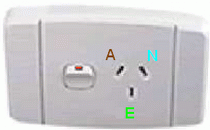
Your 230 Volts wall mains power outlet.

Picture 1 (above).
Previously, the wiring colours were RED ( Active ), BLACK ( Neutral ) and GREEN ( Earth ).
as seen in Picture 1 above. This wiring code is now obsolete and is not sold in Australia.
It was decided by international convention, trends and standards, and Asian manufacturing
pressure the Australian wiring code of colours thus became Brown ( Active ), BLUE ( Neutral )
and GREEN ( EARTH ) became GREEN / YELLOW stripe for the Earth wire.
|
|---|
Three wires entered into the appliance via a " cable entry device " which facilitated a good
safe mechanical support to the wires and cable restraint acting upon an "EnergyAuthority"
approved 230 Volt 3 wire cord.
|
|---|
The earthing wire which, when traced all the way back to the meter box, was in fact
earthed inside the consumer's " fuse box " or " power box " or " meter box " then
down via a thick green wire to an earth stake driven into the soil, usually directly below
the power " fuse box " installation. Reasonably damp soil is desirable for good conductivity
as dry soils can give rise to very poor earths. This can be quite dangerous if left dry.
|
|---|


As described above, this should be typically a moist area to facilitate good
grounding into the soil. Now, having said that, we here in Australia, use what
is termed M.E.N. system, or Multiple Earth Neutrals, which is a fancy way of
stating that the neutrals all end up in the meter-fuse-power box all connected
to the earth wire to ground.
The water utility added in a plastic isolator between the street main water
supply and the domestic or business user thus resulting in incoming the
water pipe being totally " isolated " from the street except by the conductivity
of the water within. We believe this concept is to drastically reduce lightning
penetration

The appliance, both electrical and electronic would have the earth wire
connected directly to its chassis, thus forming a safety earth return should
any problems occur with that appliance.
This concept is still a fairly good system, which is why professional equipment
manufacturers have adhered to it ! Thus, if something happens to cause any
sort of conductive path from the Live ( or Active ) side of the 230 Volts mains supply
to the metal chassis, then that " fault " current is conducted directly to earth or ground.
If the impedance of the fault current is low enough a large current will flow
and usually cause that particular equipment's " protective " fuse to blow,
disconnecting the active leg of the 230 Volts mains supply and thereby
signaling that something is very wrong, by the absence of appliance's indicator
LEDs, Neon indicator or pilot lights or just plain not working at all.
In some cases, professional equipment may have a "blown Fuse" indicator.
Looking at Hi-Fi set-ups and P.A. ( Public Address ) systems, it is not uncommon
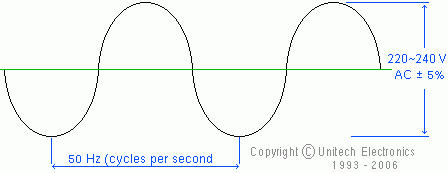
to have a noticeably audible 50 Hertz ( or 50 cycles per second of sine wave) mains hum
ever-present. This can be very annoying to hear.
In dedicated distributed video systems a 50 Hz hum can present itself as a visible
light and dark horizontal bar moving slowly up and/or down the video or television
screen.
If the hum is too severe, it can disrupt the synchronisation signals and, in some
extreme cases, cause major distortion of the TV or video image. Often in bad
cases, "tearing" at the top or at the bottom can be observed. Not on Digital TV.
|
|---|
It is a common ( stupid ) practice for " totally ignorant " ( read - morons ) persons to
disconnect the mains earths from various items of equipment until the hum ceased.
This practice must cease. Death by wilful disconnection of any earthing wires in any
system is a serious offence and should a person die as a result, expect a long prison
sentence. Sorry, but total stupidity is not a defence in court of law.
Seriously folks, it is real shame that there is no pain associated with being stupid.
The saddest thing is we cannot legislate a law for people being totally stupid.
They are among us, they are out there and please make them aware of this.
|
|---|
SERIOUSLY FOLKS, THIS IS A VERY DANGEROUS, POTENTIALLY LETHAL
AND A VERY STUPID, DEADLY THING TO DO. YOU HAVE BEEN WARNED !
We repeat the warning here, coming in contact with 230 volts AC mains will kill you dead !
One of the stupidest examples is that some Rock n' Roll singers and performers
have suffered severe electrical shocks and in some cases, electrical burns to
their lips due to the total ignorance of their "technician" or their "roadie", who
has removed the earth connection from their guitar amp thinking this will stop
the audible mains hum.
This is is just plain malignant dumb, totally stupid, very lame indeed and in fact,
as mentioned, very dangerous !. If you find someone doing this, you know
what to do. Tell them first what they did and then Sack them for being a moron .
What they fail to realise is that there is often a mains filter typically consisting mainly
of two 400V or 630V rated polyester capacitors, one from the Active 230 Volts side of
the mains to the chassis and the other from the Neutral side, connected to the chassis.
These are fairly effective at preventing RF interference and in some cases, spikes
from entering or leaving the amplifier, however when the earth connection is broken
they form a simple voltage divider with the centre-tap on the chassis ! Very Dangerous !
and Very Deadly !
Here in Australia, as well as New Zealand and many other countries where the
mains voltage is around the 230 Volts AC mark and this places about 120V ~ 170 Volts AC
on the chassis and the capacitors are usually of such a value that roughly 1 mA to 18 mA
of current can flow from the electrified, unearthed chassis to anything that is properly earthed.
So, when the singer holding their guitar which is solidly connected to the now "unearthed"
amp, touches their lips momentarily to the microphone's grill mesh, which is just as solidly
earthed by the PA system, they get a major shock in a very sensitive part of the body - their
moistened lips !....Zap !
The current flows from their hands through their chest and heart to their lips.
The current can also flow across the chest and electrocute their heart, sadly, this usually
kills the entertainer on the spot, if not they get a very nasty shock, maybe cardiac arrest.
The natural assumption is to blame their Microphone or their PA system, but all tests
of that equipment show no problem.
If the guitar amp suffers a serious electrical fault or the capacitor in the Active line
shorts out, which incidentally they do " short-out " sometimes, the entertainer or
performer could sadly and easily be killed.
This has happened before. This is not a CSI reality show, it is deadly serious.
|
|---|
DO NOT EVER DISCONNECT A MAINS EARTH UNDER ANY CIRCUMSTANCES !
Double-insulated equipment is not connected to the mains earth and most of the Hi-Fi and
Video gear intended for the domestic user is double-insulated.
Typically, the cable ( below ) whereas only two wires is used to power the appliance, the
neutral is used as a " pseudo-earth " as in the " meter box ", where the neutral is in fact
connected to the earth. the M.E.N. system. All blue go to ground (earth). 7nbsp;
|
|---|

In double-insulated gear the metal chassis is connected only to the "common" side of
the circuitry to achieve some shielding to prevent RF (radio Frequency) interference from
radiating into or out of the item.
There can be no mains filters which connect to the chassis, so at least the chance of a
shock from this cause is eliminated or at least basically minimised.
It is easy to identify double-insulated equipment because the mains power lead will
often be flat instead of round and the mains plug will only have two pins and there may
also be a symbol on the chassis - two concentric squares or put simply, a square within
a square molded into the appliance's case indicating double-insulated.
|
|---|
The DOUBLE INSULATED logo  The DOUBLE INSULATED Logo
So what can go wrong with double-insulated gear ? .... Plenty, ... as we shall now see.
All electrical equipment contains a mains powered PSU ( Power Supply Unit ),
unless it is using a "wall-wart" with an actual small transformer and some very
basic electronics, all within its small case. Some models of the conspicuous
"wall-wart" employ a switched-mode mini power supply, which here again, have their own
"leakages". It is a trade-off, cost V's efficiency.
The PSU (power supply unit) converts the raw 220V ~ 230V mains into low voltages
for the equipment's circuitry and isolates the mains from the low voltage side, well, almost.
You see, all power transformers, whether they are designed for a switch-mode supply
or linear supply, they all leak a "small" amount of current from the primary to the secondary
board earths due to stray capacitance.
In double-insulated items there is no "REAL" earth as in earth to "GROUND" per se
available to use as a shield between the input and the output, so the power supply is
designed as far as possible to minimise the leakage due to this unavoidable "leakage"
effect.
Unfortunately, switch-mode supplies run at very high frequencies, so the smaller
capacitance in the smaller transformer ends up leaking just as much as the larger
capacitance in a larger transformer running at 50 Hz here in AUstralia or at 60 Hz
in other countries for example. It should be noted here, the capacitors
used in these "wall warts" do dry-out due to the confined heat from teh transformer.
|
|---|
LEAKAGE ? eh ?......
The leakage current is usually less than 1mA and is often as low as 10uA, but even at
such low current, it can still present and still can cause problems.
Generally as a rule of thumb, the more power an appliance uses, typically the higher
the leakage will be.
Things that use an external power supply typically plugged into the wall's 230V AC GPO
(General Purpose Outlet) are not exempt either. These power supplies are
usually double-insulated and leak just like anything else connected to the mains.
Insects, dust, moisture, food particles and all sorts of miniscule bugs find their way into most
electrical equipment.
WORTHY OF NOTING
Digressing a little here.....we have noted over the years that some "silicon based" clear
or translucent sealants use to "hold" electronic parts actually attract ants, black small
ants that set about to devour the "set" or cured silicone. What you end up with is a
whole group of dead ants that gorged themeslves on the silastic. Anty-bodies, anyone ?
|
|---|
SOME SILICONE SEALANTS CONDUCT ELECTRICITY.. uh ?
It is also worth noting that some black "silicone sealants" conduct electricity.
A service job arrived and we noted the client had used a "silcone" sealant type
"black gunk" to hold some parts from moving on a Printed Circuit Board ( PCB )
and to this with a thin strip of this product cut off and removed, we were able to
measure a voltage passing through the sampled removed strip a flow of voltage.
The test scenario was Active (red) wire with aligator clip at one end 230 Volts AC going in
to the black "silicone sealant", a red multi-meter probe placed on the other end of the
dry "cured" black "silicone sealant", the black multi-meter probe with the other aligator
clip, carefully attached and connected to the 230 V AC neutral blue wire.
It was observed that the strip was noted that we could actually read a 200 volts AC that
was passing (measured) through the black silicone sealant sample strip.
At first, we thought that the fibreglass FR4 PCB was conducting, however, running the
same tests several times however, we did not get a measurable voltage flow.
Most Interesting we throught !
Returning to the "black "silicone sealant" strip, we ran several tests without the black
strip of "silicone sealant" on clear acrylic as the support medium, also on dry plywood,
over cardboard, six tests on each medium background supporting our findings, that the
black "silicone sealant" test strip was in fact conducting and it could be seen to be
virtually the exact same result with our various six multi-meters. Go figure !
These results shocked us, however, we were not surprised by the unusual results.
Lesson learned, not all "silicones" are in fact unsulators.
With the complete removal of this "black gunk", clear neutral cure silastic
applied, the client's electronic gear worked. So, this shall be duly noted.
|
|---|
Do capacitors actually dry out ?
Yes, electrolytic capacitors do dry out and the di-electric medium separating the "plates"
can form "chemical" short circuits, thus reducing their effectiveness as a smoothing
capacitor. Also the use of low temperature rated capacitors does not help.
Do batteries actually leak out ?
Simple answer, yes.! Most sealed Ni-Cad batteries and other non-rechargable
alkali batteries can leak their corrosive alkali contents onto the PCB , usually eating
away at the copper tracks and in some cases, where a multi-layer circuit boards
are used, the tracks get eaten away by the alkali, which acts like an acid and follows
the copper into the layers of the PCB. Not good !!
Please check here for ACID EATEN PC BOARD information.
Do electronic parts actually overheat ?
Simple answer, again yes. Components can overheat or be damaged in a hundred
other ways. Do not despair, it is not all gloom and doom.
Most electronic equipment lives on past the warranty period and in some cases, well
past the "extended" warranty period also, some times over 10 years or more.
Hint: if you mount a small well oiled bearing 12 Volt mini fan inside the device, it will
keep electronic parts cooler, thus ensuring that their "life span" is somewhat extended.
Do transformer windings short circuit ?
Again a simple answer, yes.. Insulation gradually loses it's "plasticiser" due to age,
even exposure to UV light and heat from thermal cycling to mention just a mere few causes
and becomes brittle over time. Not good !
Insulation in transformer windings degrades over time due to vibration and the
enamel or lacquer detaching and heat expands and contracts, thus moving the
winding, albeit a few microns, but worthy enough to note..
Unless all the " lams " ( laminations ) are secured by a transformer lacquer or
are screwed together tight ( in the case of E-cores ) the laminations will vibrate
over a period of time.. This can translate into problems over time.
Problems that no-one needs.
It would be reasonable to understand that a sealed transformer, ie: potted and set in
a resin would be the best selection for a transformer. These come with PCB connecting pins
protruding from below to solder to the underside (foil side) of the PCBoard.
All these things can conspire together to cause electrical leakage (or even short-
circuits) to the unearthed chassis of double-insulated gear and, guess what ? All of a
sudden it's not insulated at all !
|
|---|
Crappy or rather poorly designed PSU designs also can contribute to the lengthy list of
usual and unusual suspects. The introduction of an earthed item into a system made up of
double-insulated gear is not unlikely, but it is somewhat likely to be the start of some rather
"interesting" problems.
Let's say you have a DVD player, two VCR's, a TV/Monitor, a CD player, a cassette deck,
a Pre-amp, perhaps a Graphic Equaliser, ..... I think you get the idea .......
All these things are double-insulated and they are all connected to each other either
directly or through one of the others. The leak current all adds up.
It would not be unreasonable to expect any where from 0.1 mA to 1.0 mA ( or even more )
of leakage from the combined equipment because the leakage currents simply add together
and increase the leakage figures.
If you were to connect a digital multimeter between this "pile of gear" and the chassis
of your new item, let's say it is a big brute of a surround sound amplifier which just happens
to be earthed, you will measure a very significant ac voltage, probably at least half the mains
supply or even higher.
|
|---|
Don't try to measure the current, unless you know what you are doing, you
might blow up your multimeter if there's a bad fault or worse, Kill yourself !
Warning, coming in contact with 230 volts AC mains will kill you dead !
Now, let's say you have the metal shell of an RCA on an audio cable which is connected
to an output on the un-earthed gear in one hand and you steady the amplifier with your
other hand as you start to plug it into an input.
As soon as you complete the circuit between them you will get a mild electric shock, we
have read on our Digital MultiMeters, ( three were used to get the average ) 105 Volts AC at
about 15 mA (Milli Amps). Nasty little "bite" from it too.
Depending on how moist your skin is and how high the leakage is this might be unnoticeable
or it might cause you to more than likely say a bad " $@^%& " swear word !
Unless you have a bad heart it is unlikely to hurt you physically, but it can give you quite a
sting, especially when you do not expect it.
Once the first connection is made and the leakage is flowing to ground, there will be no more
tingles.
|
|---|
Warning, coming in contact with 230 volts AC mains will kill you dead !
A Typical Australian mains power plug

Warning, coming in contact with 230 volts AC mains will kill you dead !
OK so far .... HUMMING ALONG ......
You might notice though, that your previously hum-free system is now humming and quite
annoyingly doing so. So, what changed to get this terrible effect ?
The hum might be affected by the volume control on your amp or not or it might only record on
tape or it might be visible on your TV or ... so,....What do you do? That's a very good question
and one which deserves a really good answer. Unfortunately, there is no real simple and easy
answer, but now that you know a bit more about where the hum comes from by now, an orderly
and logical disconnection and re-connection of the whole system will locate the major culprit.
With the assistance of a C.R.O. Note: a C.R.O. is not a large Australian meat eating black bird.
Any Cathode Ray Oscilloscope that measures 10 MHz is fine. Work with what you have, this is a
very good thing.
|
|---|
MEASURING THE HUM .......... AN OSCILLOSCOPE TO THE RESCUE
Generally the higher the Megahertz (million cycles/second), the better the measurement.
We use a RIGOL (DSO) Digital Storage Oscilloscope with a fully featured Liquid Crystal Display,
with 4 separate channel probe inputs 100MHz, color LCD screen and more bells and whistles and
fantastic features and benefits than I will ever use or our older trusty 60 Mhz Hitachi V-680 triple
trace with its On Screen Digital display, yeah, it's a slight, um..... over-kill to measure
50Hz, a simple 10MHz C.R.O. (Cathode Ray Oscilloscope) will do just as well for 50 Hertz (Hz).
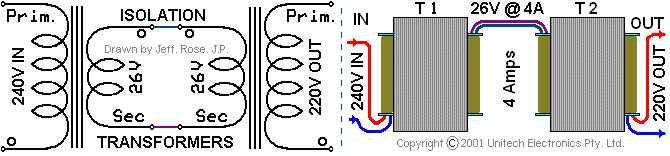
It is important to bare safety in mind. We use an isolated mains supply, that is to say, we have
two 4.3 Amp transformers wired secondary to secondary, ( 26 V AC to 26 V AC ) 230 Volts AC in
and 220 Volts AC out. It doesn't get any better than that and this re-cycles the Power Supply
Units (PSU's) from becoming scrap metal or landfill. .
|
|---|
Commodore-AMIGA A500 Non Resin Filled power supplys were chosen for two main reasons.
( A ) They are 240 V AC input rated and they have multi-tap voltages on the secondary output
and are well designed and well manufactured, excellent windings and in using one of the
output voltages on the secondary, the 26 Volts AC, this secondary voltage is rated at a full
4.3 Amps constant output current, which will do the job more than adequately.
( B ) The second was we had them as left-over service stock and may as well use them.
These came out of Commodore-AMIGA A500 Power Supplies and were easily fitted within the
A500 power supply plastic case. The output is a flying 3 pin plug (AUSTRALIAN) and 1.2m
of mains lead with a (Australian) plug.
Using our C.R.O., this lifts the C.R.O. or D.S.O.( with the earth to the CRO or DSO disconnected)
above mains potential which is the safest for your equipment and for personal safety reasons.
Most well made transformers can be paired / wired back-to-back, secondary to secondary and
will tolerate fairly lengthy usage on full power isolation. It is preferable to incorporate
a "externally accessable fuse" rated at least 2.0 Amps to be able to provide enough GRUNT
in Amps to safely drive your CRO or D.S.O. and the equipment you are testing.
The reasoning here for being greater than 2.0 Amps, is the oscilloscope may draw larger
current than you may and this could create an overheating problem in the primary windings
and naturally a much lower output voltage than you perhaps expected. As mentioned, we
chose a 4.3 Amp pair of transformers for a good reason, these work fine under load conditions.
|
|---|
Below is our own simple example of how to make your own " ISOLATION TRANSFORMER ".
In essence, two AMIGA A500 ( ventilated 4.3A heavy brick ) power supply transformers were
chosen for our own personal safety applications, for testing under safer working conditions.
The small power regulation PCB and electronics, along with its aluminium heat sink was totally
removed and the extra transformer was placed inside and stuck down with a top quality Selley's
"Silastic" Neutral cure making it adhere to the plastic A500's (PSU's) Power Supply Unit's case.
The existing ON/OFF switch was used as well as the original 230/240V AC power in cable. A single
2 Amp fuse was incorporated between the active wire "switched" and the primary T1 transformer
for safety. As a prime safety requirement, both transformers must be correctly earthed to the
original 3 wire cord (Green / yellow wire) that enters via the mains in 230V lead. A short length
of mains flex exits the Power Supply unit case via the old "low voltage" square hole via a cable
restraint. To this is correctly added a female Australian mains socket. 240V AC in, 220V AC out.
Here in Sydney, our local mains supply is sampled prior to and during testing to see what voltage
is currently being fed to our equipment and we have often found 242~252 Volts AC measurements
made on our trusty "DMM" Digital Multimeter. Yet we have been fed information that the mains
voltages are now 230 Volts AC as a standard and not our "old" 240 V AC standard since it was
introduced as the " norm " here, well over 120 years ago. As well, we invested in photo-voltaic or
solar panel cells, all 18 panels to reduce our electricity bills each quarter. I seriously wonder if it
was worth all that expense, in consideration they are far less than 50% efficient, they do not work
after the sun has gone and do not deliver good output on overcast cloudy/rainy days. Their best
output is at greatest from 10:00am, to peaking at Midday, dropping off at 2:00pm, on sunny days.
|
|---|
If you have been unlucky, you might also notice that first input you plugged in is now quite noisey
or somewhat "distorted " or just plain not working at all. If all else fails, R.T.F.M. or as it literally
means, Read The Flamin' Manual.
Ever wondered why they state in the instruction manuals that you should always disconnect the
power when making or breaking connections to anything ? It is for safety, yours and the device's.
Well now you know ! It's to avoid shocks, huge hums, loud crackles and damage caused by high
voltages being connected / disconnected to sensitive inputs before the common/earth/ground side
manages to short-out the dreaded mains leakage or possibly your own static-electricity build-up
from contact with nylon or plastic in walking. See the 3M manual. It's about 75mm thick.
Read the 3M manual devoted entirely to this subject so you understand what you are about to do.
Play "safe" and always read your manuals on how to operate equipment safely! These manuals
are written with your safety and best interests in mind. Please familiarise yourself with all facets
of correctly operating your electronic equipment. Your must look after your valuable investment.
|
|---|
It might be a nuisance, but it does avoid all these problems, and could save your life ( or at least
that of your other gear ) if one of your double-insulated ' what-ever' happens to have a serious
electrical fault or a bit more leakage than your other equipment can tolerate.
Lastly, this tale, only one of so many, it has to be told. So one day, one of our newer customers
rang us one day to order some special length VIDEO and AUDIO cables.
Nothing strange about that, however his next request had me indeed quite intrigued as well as very
puzzled !
The customer wanted the cables totally insulated, that is, with no exposed metal anywhere.
Yeah Right !
Now, get this, some one, a supposed techie, said if you want to reduce problems, insulate all cables.
Oh really?
I questioned him as to " the thinking " behind this and asked why, his quick reply was " Because
he gets really bad tingles and mild shocks from exposed connectors from his video editing suite
and his Asian TBC ( Time Base Corrector ), when he re-configures the Video or Audio wiring to
other video equipment he wishes to utilise".
So, upon further questions, I was informed that he had 4 ordinary VCR's, a Time Base Corrector),
(TBC) a Non-Australian made Genlock and several Philips 13 " Audio/Video monitors as well as
his computers. The computer and the surprisingly, the UK Genlock were the only items that
were earthed during manufacture, all other equipment he used was of the " double insulated "
floating above earth types. The computers were very well designed Commordore-Amiga A500's
and as these were designed in 1988 to output color from a palette of 16 million colors and tones.
These are the very same computers that were in every club that had "CLUB KENO" running from
1989 to 1999 on a club's single 1 Megabyte of RAM AMIGA A500, an A500 power supply, a 880K
bootable floppy disk, a 14,400 modem and sometimes, a RF Modulator connected to the rear 23
way male VIDEO PORT connector that delivers the Amiga's excellent Video broadcast video output.
They are designed to be the least of the worries regarding "bad earth loops", "intollerabe hum"
and " bities " that other electronic gear can exhibit under normal video/audio production usage.
|
|---|
And Sparks may fly ....
At one stage, a " bright spark " suggested that he remove the earth wires from both Genlock and
computer, which of course would do nothing and make the whole setup totally "floating" above
earth potential. I conveyed to him that this suggestion made me truly horrified and explained
that the results of this may contribute to the deaths of some-one later down the track.
Well folks, that seriously, is as dumb as a box of rocks ! It does not get any more dangerous !
I arranged for " house-call " by a colleague to visit him, he is a technically competent electronics
technician and a very electronically " savvy " friend of mine who's job it was to " go over " his setup
and in consultancy with myself. We ended up attaching a 220nF (0.22uF) Class X2 400V AC
poly caps to the rear of each VCR's lid temporarily as shown in the two drawings below ( undo the
screws and add in the caps with an "earth lug" ), this also preserved his 4 VCR's warranty ( by not
adding anything inside his VCRs ) simply a "lug" under a screw on each device.
This rectified his zapping problem, the AC present was to the order of 127 volts measured by a DMM
and a a CRO ( Cathode Ray Oscilloscope ) with about 27 mA ( milli Amps ) of current flow measured
on the digital multi meter. Some may say this is an inherent acceptable situation found in
switched mode power supplies and just accept it as such. We reject this concept and slack mind
thinking. While it can be argued that with applied mathematics, better filtering, improved design
applications and choice of voltage controlling semiconductor components will improve this problem,
it all comes down to production costs, accountants sticking their " bib " in to cut costs and so on.
The bottom line is costs, absolutely. How much is the consumer prepared to pay for a correctly
designed product or electronic item ? Perfection costs money. More parts = more consumer costs.
|
|---|
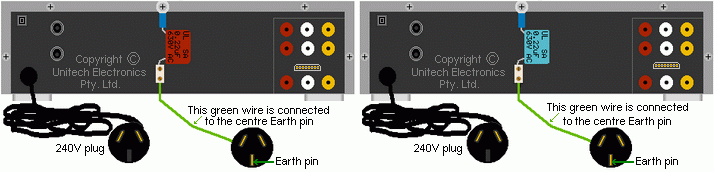
This certainly assisted in getting rid of the considerable ' leakage " of the 4 VCR's and the T.B.C,
contributing to the mild electrical shocks and some of the hum. Oh..to live in an electronically
perfect world !... that would be ideal. Note: We used TBCs (Time Base Correctors) here as just one
example. The same applies to many other sophisticated electronic and double insulated devices.
You will note that for absolute simplicity, I have drawn 2 VCRs with bare components shown, this
is NOT how the completed item should be wired and all items should be housed in a safe and sealed
small UB1 PVC 4 screw lid plastic box for safety reasons.
It would be electronically better to place all parts in a very small " jiffy " box with double sided tape
or VELCRO all from either Jaycar or Altronics or your local reliable Electronics specialist supplier
in your country.
The 0.22uF class X2 capacitor should be wired up as shown in the small drawing below and it is a
good idea to connect all the earth bound wires into on 230V plug. Do not try to be creative and wrong.
|
|---|
                        The Parts list.
                           1 x 3 pin mains plug (wire all earth wires in last of all).
                           1 x 22nF ( 0.22uF ) Class X2 polyester capacitor rated at 400V ~ 630V AC. Must be X2 Rated.
                           1 x Small plastic box,about 50mm x 100mm x 80mm or similar
                           1 x crimp "ring eyelet" per appliance, for, say 2 appliances ? Two will be required.
                           1 x 2 way mains insulated terminal screw block per appliance.
                           1 x strip of quality brand double sided tape (or hig quality velcro tape).
                           1 x small nut & screw 10mm to hold the terminal block.
                           1 x strip of 10 terminal blocks, cut into two per box.
                           1 x length of 230V mains rated flexible green earthing wire,
                           1 x Mains surge protector power board to suit all your devices.
                           4 x Quality made small cable ties.

                    NOTE: You may also wish to consider the additional circuit concept ( below Fig. 3) as a adjunct protection.
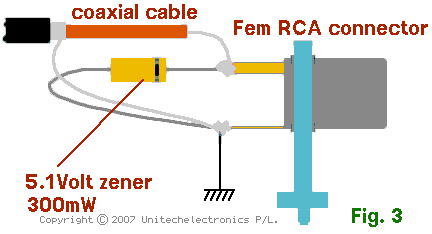
Above you will note ( in Fig.3 ) the simple representation of a RCA connection, note at the video cable
entry( on the left ) it is connected to the "hot" tab of the rear of the RCA female connection along with
a 5.6 Volt 400 Milli-watt zener diode, this also we have found to be an excellent clamp against those
nasty " bities " that are often encountered with connecting to RCA connectors on " switched mode "
powered electronic equipment which mostly comes out of South-East Asia and widely used these days.
Hey ! ..... It works.
|
|---|
                          The Parts list.
                              1 x 400 Milli-watt 4.7 Volt ~ 5.1 volt, a 5.6 Volt zener diode being the Maximum.
                              1 x Small amount of solder to be skillfully applied.
                              1 x Time to correctly and carefully do the job correctly.

                              Note: The addition of several 5.1 Zener diodes on all RCA sockets did in fact "clamp and stop the "Biteys"
                              from sparking when connecting other switched-mode devices.    It was amazing actually, one did not need to
                              dim any lights to see the actual " small sparks " that passed from the VCR or DVD player to the RCA cable.

Disclaimer
                        1.  All the contents of this Unitech Electronics web site are for general information or general use only.
                            They do not constitute expert advice and should not be relied upon in making or for that matter in
                            refraining from making any decision.  Any specific advice or replies to queries in any part of the
                            Unitech Electronics web site is and are the personal opinion of such experts/consultants/persons and
                            are not subscribed to by the Unitech Electronics web site.   In Australia mains 230 ~ 240 Volts A.C.
                            does in fact kill you. You do not get a second chance. Do NOT PLAY WITH MAINS POWER.

                             We repeat the warning here, coming in contact with 230 volts AC mains will kill you dead !

                        2.  The information from or through the Unitech Electronics web  site is provided on an "as is " basis and
                             all warranties, expressed or implied of any kind, regarding any matter pertaining to any goods, service,
                             including without limitation, the implied warranties of merchantability, fitness for a particular purpose,
                             and non-infringement are disclaimed and excluded.

                        3. Unitech Electronics. Pty. Ltd. ( www.unitechelectronics.com ) and / or any of its associates shall not be
                            liable, at any time for damages (including, without limitation, damages for loss of business projects, or
                            loss of profits) arising in contract, tort or otherwise from the use of or inability to use the Unitech
                            Electronics web site, or any of its contents, or from any action taken (or refrained from being taken) as
                            a result of using the Unitech Electronics web site or any such contents or for any failure of performance,
                            error, omission, interruption, deletion, defect, delay in operation or delay in transmission, a computer
                            virus, a communications line failure, theft or destruction or unauthorised access to, alteration of, or
                            use of information contained on the Unitech Electronics web site.

                       4.  No representations, warranties, or guarantees what-so-ever are made as to the accuracy, adequacy, reliability,
                            completeness, suitability, or applicability of the information to a particular situation.  Projects described
                            here-in and here-on viewed on this web site are to be used at the absolute sole discretion of the user.
                            The information contained here in was simplified so the average person could understand without the
                            need for a degree in electronics engineering nor a major in applied sciences.
Copyright © 1985 - 2015 Unitech Electronics Pty. Ltd. - Celebrating 37+ years in Business.






sales@unitechelectronics.com






